Project Background
Royal Oak is raising money to help the National Trust conserve Saltram’s Velvet Drawing Room.
Saltram is one of Britain’s best preserved early Georgian houses at the heart of an 18th century designed landscape in a commanding position overlooking the Laira estuary and the Atlantic port of Plymouth. It was not far from Saltram in 1620 that the Mayflower set sail carrying the Pilgrims who after 10 weeks at sea dropped anchor near the tip of today’s Cape Cod in Massachusetts.
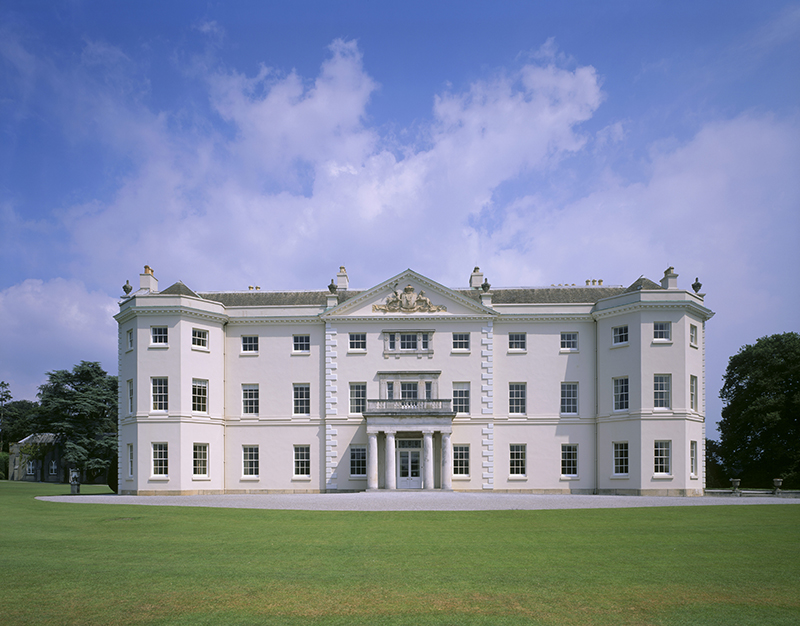
Saltram House in Devon © National Trust/Rupert Truman
The owner of Saltram at the the time of the Mayflower’s departure was James Bagg, an investor in the Plymouth Company which was chartered in 1606 to settle areas of Virginia. In 1620, this was re-chartered as the Plymouth Council for New England. Bagg played other key roles in the busy port of Plymouth, not least as Controller of Customs.
The transformation of Saltram into the impressive mansion we see today began in the 1740s, after John Parker I (1703-68) inherited the house from his father. Over successive decades, the family’s vision as patrons shaped the house into a neoclassical showpiece.
Like her mother-in-law Lady Catherine Poulett before her, the Honorable Theresa Robinson brought a cosmopolitan flair to Saltram when she arrived in 1769 as the new wife of John Parker II. Inspired by their upbringings, both women saw Saltram as a project: a house to refresh, redecorate and fill with beauty. John and Theresa worked with Robert Adam, arguably the greatest exponent of the neoclassical architectural style, completing the transformation of Saltram from a Jacobean house into a sophisticated Palladian mansion. Theresa’s passion is clear from a letter written by her brother Frederick which recounts changes she made to the Velvet Drawing Room.
Saltram house and parkland offer a serene escape within the city of Plymouth welcoming upwards of one million visits a year. Strolling along riverside paths or through the wooded glades of the 18th century designed landscape, visitors can almost forget the city that lies beyond. Today, Saltram is a much-loved feature of Plymouth; a vital source of natural and cultural heritage.
From a letter dated September 11, 1770 written by Frederick Robinson, brother of Theresa Parker: “Therese with her usual taste ordered all the mouldings, & parts of the Capitals of the Columns to be Gilt, which makes the Room much chearfuller & handsommer”
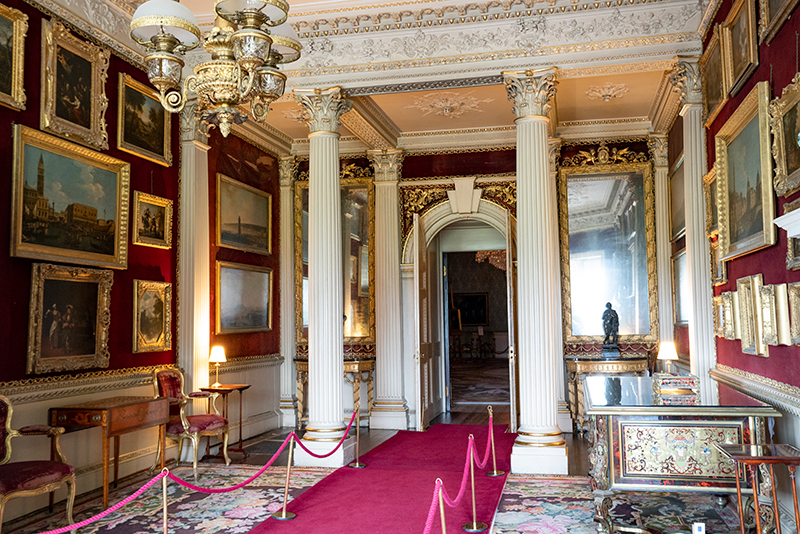
The Velvet Drawing Room at Saltram. The pier glasses and tables were designed by Adam in 1771 and made by Perfetti. © National Trust/Sophie Bolesworth
The Ante Room to Robert Adam’s Saloon
Saltram’s Velvet Drawing Room is the ante room to Robert Adam’s Drawing Room (now Saloon) possibly the finest example of his ‘complete design’ approach. Adam created the Saloon and the Library beyond (now the Dining Room), as well as re-working the exterior of Saltram, between 1768 and 1772. He designed refined and intricate painted plaster ceilings, crisply carved marble chimney pieces and created furniture and carpets for his grand new spaces.
The Velvet Drawing Room dates from c.1740-50, and its style sets the direction for things to come. In 1771, Adam designed a pair of half-moon pier tables and accompanying glasses for the Velvet Drawing room, to flank the doorway leading into the Saloon. They are gorgeously gilded, and exquisitely carved with urns and acanthus leaves, sphinxes and fine swags.
The Velvet Drawing Room is a miniature temple, its colonnade with gilded Corinthian columns accentuating the dramatic transition from the warm intimacy of its red velvet-lined interior into the light and lofty neoclassical perfection of the Saloon.
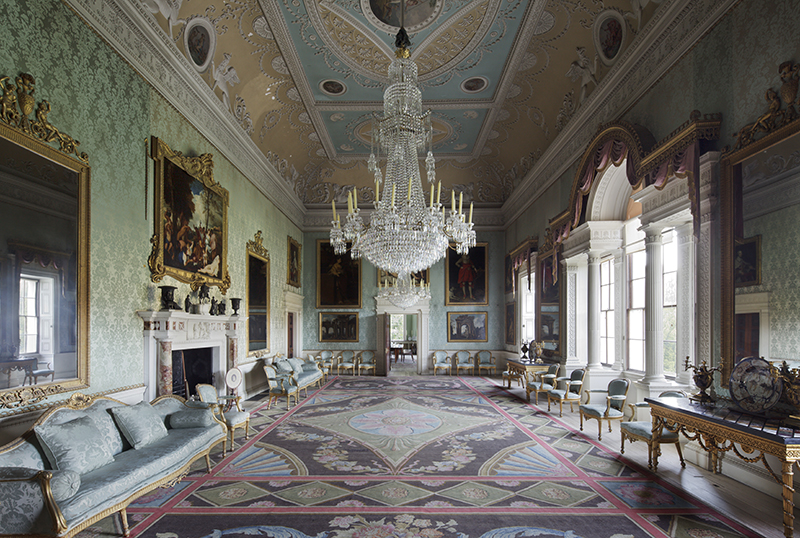
The Saloon, or Great Drawing Room, at Saltram © National Trust/Sophie Bolesworth
Key elements of the conservation project include:
- Replacement of deteriorated and torn original 18th century Genoa silk velvet wall hangings in the colonnaded end of the Velvet Drawing Room with silk velvet commissioned to colour match the original hangings.
- Purchase of silk velvet, produced as part of the same dye batch, with a view to replacing the mid-twentieth century red flock wall hangings around the rest of the room and the modern upholstery of three window seats comprising part of the room’s original set of English carved giltwood seat furniture c.1775.
- Removal, repair of losses, and replacement of the original 18th century pierced gilded paper mâché fillet around the edges of the wall panels to enable the taking down of the deteriorated silk wall hangings.
- Replacement of losses and conservation of the pair of giltwood pier glasses (mirrors) and side tables designed by Robert Adam. The tables which were made by Joseph Perfetti have numerous losses of decorative elements.
- Commission protective silk covers for part of the set of twelve giltwood chairs c.1775 historically in the room. The chairs are upholstered in the original red Genoa silk velvet also hanging on the walls in the colonnaded end of the room. The silk on the chairs is worn and very fragile. Protective covers would enhance the care of the chairs and the interpretation of their design. The fragile carved giltwood and gesso chairs displayed in the room would also be conserved.
- Consider the method of hanging and conservation needs of the paintings in the room including works by Pieter De Hooch, Joshua Reynolds, and Jacopo Fabris. In the colonnaded end of the room, take down, upgrade frames and hanging fixings, consolidate, minor cleaning and inpainting, and rehang four paintings by Riccadelli.
- Analysis, replacement of loses, and re-decoration of gilded and painted decorative features incorporating gold and metal leaf, gesso, carved wood, and plaster.
- Install museum grade lighting and mesh blinds to enhance the experience of the collection, interior, and view of the 18th century designed landscape through the three windows. Light sensitive wall hangings and textiles mean the existing blinds are often fully down in the south facing windows. Mesh blinds would improve light levels, heat control, and conservation of the collection.
- Replace the copy c.1902 of the original carpet made by Thomas Whitty of Axminster c.1765-80 who wove the Saloon and dining room carpets designed by Adam. The carpet has stretched so that it runs up the skirting board and is protected by a drugget to create a walkway for visitors. A reweave or alternative solution would increase access to the room and the collection whilst protecting the floorboards.
DONATE TODAY


